When I first got here I took a trip to a small terrace town called Batad. To my surprise, the inn I stayed at offered pizza on their menu. I tend to believe that you should always eat what a local culture makes best—not their western food attempts. But what they tend to make best around here is boiled meat, boiled vegetables, and rice. Besides, the thought of pizza while sitting outside looking out over a mountain of terraces tempted me too much to resist.
A half hour after we ordered, the woman brought the pizza out for my friend and I; one was simply grilled onions, garlic, and a little bit of cheese, and the other was a combination of tomatoes, tuna, egg, and a few other things—an Australian favorite, according to my Aussie friend. They were both tasty, but I couldn’t figure out how she’d made the pizza without an oven. She told me she heated it in a pan with a cover on top. Though it wasn’t gourmet—she inspired me to figure out how to do the same.
There’s a device here called a Philcraft—it’s a Teflon pan with a lid that shuts tight. You put it over the stove and the Teflon and outer metal cover heat whatever’s inside pretty evenly. People make brownies, cookies, and pancakes in them…so I figured we could try a pizza. I got Adam all excited about it and we decided to go for it one Sunday afternoon.
The pizza making coalition
A half hour after we ordered, the woman brought the pizza out for my friend and I; one was simply grilled onions, garlic, and a little bit of cheese, and the other was a combination of tomatoes, tuna, egg, and a few other things—an Australian favorite, according to my Aussie friend. They were both tasty, but I couldn’t figure out how she’d made the pizza without an oven. She told me she heated it in a pan with a cover on top. Though it wasn’t gourmet—she inspired me to figure out how to do the same.
There’s a device here called a Philcraft—it’s a Teflon pan with a lid that shuts tight. You put it over the stove and the Teflon and outer metal cover heat whatever’s inside pretty evenly. People make brownies, cookies, and pancakes in them…so I figured we could try a pizza. I got Adam all excited about it and we decided to go for it one Sunday afternoon.
The pizza making coalition
 Somehow the pizza making turned into a huge affair. Adam and I went to the market with some of the kids next door and bought tomatoes, pineapple, onions, and garlic. We told one girl at the market what we were up to as we thought about what kind of toppings to buy.
“What do you think we should put on it?” Adam asked her.
Within a second she replied, “Hotdog.”
Hotdog. That’s how you do pizza Filipino style. Adam looked over at me and raised his eyebrow. I shook my head. No hotdog.
The whole process took us about four hours. The neighbor kids cut and chopped the tomatoes, onions and garlic for the pizza sauce that I insisted should be made from scratch. I didn’t want to use Filipino pizza sauce recipes—all of them had sugar and MSG. Filipinos love sweet pizzas and they put MSG on everything. So, we ended up cooking the sauce and then blending it down. It wasn’t quite what I wanted—it didn’t have the tart flavor that usually comes from tomato paste—but it was good. I had kids grating cheese, cutting pineapples, peeling garlic, chopping onions and crying. Actually I did most of the onion crying—the little onions we used, while seemingly small and innocuous, were brutal.
One thing we realized afterwards is that good cheese really makes or breaks a pizza. All they have for “cheese” around here (besides Filipino soap operas) is a brand called “Eden Cheese.” It’s basically a block of cheese whiz. Faced with Eden cheese or cheese-less pizza, we figured we’d try it with the cheese.
Unfortunately all of our momentum stopped once we had to cook the pizzas. I wasn’t sure how long it would take to cook the pizza so that the cheese would melt and the crust would cook without getting burnt. I cooked one side of the crust for awhile—since it wouldn’t get grilled from the top like in a normal oven—and then flipped it over and put the sauce on. Then I just let it cook on low for about twenty minutes or so.
Pizza in the Philkraft
 The pizza turned out alright. We put a few hardboiled eggs on one (won’t do that again) but the best was the tomato, cheese and pineapple. A few wonderful things happened as a result—the pizzas got eaten up by the family, who claimed they were delicious, and we got to skip dinner since we were cooking which consisted of some kind of cooked intestines.
I was kind of disappointed with how they turned out. I tried to avoid expectations—I knew it wasn’t going to be like real pizza, but the Eden cheese was horrible. I can’t stand cheese whiz, and it just took away from all the other flavors. The pizza crust, a yeast-free recipe, wasn’t that fantastic either. Mostly though, what deterred me from ever making another pizza was the time it took to make it—four to five hours for four pizzas. It was kind of a sad and funny moment—we tried so hard to recreate something American here, but in the end there are some things you just have to leave back home till you return.


 After dinner one night, Lola offered us moma after dinner. Short for “wahana chimomam?” in Ifugao—have you some betel nuts?—moma used to be an Ifugao greeting, a way of asking how the other person was. Moma chewing combines at least three elements: moma, a piece of betel or Areca nut—the seed of the betel palm, hapid, tobacco leaves (optional), and apor, a white powder made from lime or crushed snail shells. These two or three items are usually wrapped in a betel palm leaf and chewed or sucked on for up to several hours.
 Chewing moma requires frequent spitting—as one writer, Stephen Fowler says, “you don’t just salivate, you pour.” In Ifugao, you’ll see the sidewalks covered with bright red splotches. When I first got here I thought it was blood; I wondered if maybe they butchered their chickens and let the blood drip on the streets. But after a few days I realized what it was. You have to be careful around here. I’ve been warned more than once to watch out for buses passing by; sometimes men sitting on top of a jeepney will spit off the side and hit a passerby, staining their shirt permanently. There are signs around some towns in the province: DO NOT SPIT MOMA HERE, but I haven’t seen those around Banaue.
 Photo by Theo Vermulen
 Just when we got started, Adam got a text message. “Gotta go!” he said, “gotta Skype Eva.” He ran down the stairs to chat on the internet with his girlfriend and I suddenly felt alone and awkward.
 Photo by George Hallit
 I spent a large portion of last weekend (February 10th and 11th) underwater. I joined two Americans—both working at the embassy—in a dive course in Manila, and then we drove two hours down to Batangas to get checked off on open water dives. I’ve always wanted to get certified, and the Philippines has some of the best diving in the world. The region’s coral reef areas are part of what’s known as the “Coral Triangle,” which includes Malaysia and Indonesia and is considered the center of the most diverse marine habitats.
 But more than anything, it seemed to me like the coral wasn’t as healthy as I hoped it would be. Coral reefs are really sensitive ecosystems and they’ve suffered a lot of recent damage. They’re usually near developing countries, which is a challenge because often times they don’t have the same environmental standards and resources that more wealthy countries do.
 Tourism—like my SCUBA diving adventure—is both a blessing and curse. Irresponsible boats anchor onto the coral and break it off—killing decades of growth (how fast to coral reefs grow?). Also, people touching the coral, with their hands or fins, can destroy it. The good news is that educating people about the reefs, inspiring them and connecting them with it, is a great way to raise public awareness and stewardship—but developing countries with corrupted governments have a hard time implementing any serious measures. It’s up to the tourists and the guide companies to be responsible.
 Lastly, climate changes found during El Nino and with global warming have a devastating affect. Temperature changes of a few degrees can cause coral bleaching—which kills it off. According to The Nature Conservancy, if coral reef destruction continues at its current rate, 70% of the world’s reefs will be gone within the next 50 years. Not only does this affect biodiversity on an unfathomable scale (think of the food chain that depends on this reef community) but the loss would also be an economic disaster for people living in the tropics. At any rate—I had a tough time seeing how damaged some of the reefs were, but it also inspired me to remember how connected the rice terraces are to the reefs—deforestation up there has an affect on the reefs as well.
 Picture by Henry Boer
 One thing to keep in mind if you’re crazy for aquariums—don’t get Clown Fish or anemones! Huge numbers of anemones have been torn out of the ocean for aquariums by Nemo loving kids. It’s ironic that so many people who rooted for Nemo’s escape from the aquarium caused the real Nemo to suffer the same fate. The fact is, very few people can keep either species alive for long and their removal from their native habitat is really destructive. In fact, all coral aquariums are devastating to coral reefs—so, if you know anyone contemplating getting one, maybe you can inspire them to SCUBA in the tropics or watch Finding Nemo instead.
  One of the other great parts of the weekend was just relaxing on the beach. I got a wicked sunburn (it’s still sore five days later), but it was so wonderful to have delicious food and wonderful weather down in Batangas. I’m really looking forward to diving in Bohol at the end of March—the diving is supposed to be fantastic. Getting my certification was certainly a wonderful gift to myself—and I’m looking forward to the adventures ahead.
  Clownfish pic found on this website:

 But then we heard about another destination, even higher up that Chapa. They call the site Holy Water. On our way back from Chapa Falls, we asked a few people where it was. “Hichi,” many said: far away. They’d wave their hands towards Chapa Falls and that was the end of it. Finally we met a familiar woman sitting on the steps of a long staircase up to the marketplace.
 The sun struck down. The view expanded below us. My legs strained, which embarrassed me as I’ve spent months hiking up mountains in the past. I just arrived from Manila a few days before and hadn’t made up for the sleepless night on the bus. Mart, the 13 year old from next door, bounded up the steps as Adam and I huffed along after him. We stopped numerous times to ask directions. Mart was too embarrassed to associate himself with us—we think he might have been worried people would think he was a tour guide as many youth his age often are. For the most part, Adam ended up asking where Holy Water was in his limited Ifugao. I just trailed along behind, catching my breath.
 “Chana chi Holy Water?” We asked again. The people pointed to a white pagoda sitting on a terrace.
 We hiked along the terrace walls and walked up to the pagoda. Inside a Virgin Mary statue held her hands in prayer. Above her, a sign read, "The Lord says: Ask and you will be given, seek and you will, knock and it will be open to you." Beneath her a small pipe leaked out water into a shallow pool below. I walked in and sat on a bench, grateful for the shade. Adam stood at the entrance, skeptical.
 “I refuse to accept that this is Holy Water,” he said. I laughed at first, then looked at the two locals with us.
 “You can drink it?” I asked. He nodded. I realized it was a spring—a lot of the water in Banaue is. I walked over and took some as well. We sat there in the shade for awhile, drinking water and eating a bit of bread.
 “I still can’t accept that this was it,” he said. “What a let down. But man, I love it up here. It’s totally beautiful—you can actually hear the birds. I’d love to explore this place more.”
 Sometimes I get a little wacky over there—here’s a picture of me with doll shoes on my fingers. Check out the other entries, which hopefully offer a small glimpse into the family life.


 Every one except Auntie Lourdes thought we were nuts. She had actually done demonstrations to sell the juicer some years before and knew how to work it—it was actually a Cuisenaire and juicer combo. But who wants to juice vegetables? Most people don’t even like vegetables here very much—they prefer meat and rice. I suggested we juice the apple and carrots first because it would be sweet and everyone would probably like it. We juiced about two cups worth and passed it around to the family members. I tried to read people’s facial expressions to get their real reactions. For the most part, they seemed to like the carrot-apple, as weird as it was to them.
 So that’s what we did. For some reason, the pechai-carrot-apple fritters were orange initially, but turned green when cooked. So, we told a few of the family members that we were having lizard meat for dinner, which worked like a charm. Eventually, they all saw through our ruse, but with a little ketchup, the veggie fritters were pretty tasty. The next night we had carrot fritters. Lola, who’s a trifle deaf in one ear, thought someone said the carrot fritters were caribao—water buffalo. So we called them carrot-bao fritters, surprise, surprise. Carrot-bao and lizard meat. Yum.
 I’m not sure we’ll juice a heck of a lot more though—we had to go through way too much work to figure out how to use the greens left behind.
 Read about the organization Adam's working with here:
  Photo from Wikipedia
 from Wikipedia
 As the jeepney wound down the mountain, a small group of us perched on the top—gripping the rack below us. Riding on top of the jeepney, while a bit unnerving, offered the best view, the cleanest air, and the most adventure. A SITMO volunteer sat on top with us and chatted about the verdant scenery around us as we headed to a hot spring near the terrace community we’d visited the day before.
 Within a half hour, we were hiking through terraces, along dirt walls, cement irrigation channels, and over rocks. Many of the tourists had no idea what they were getting into. The direct sun was hot and the hike to the promised hot springs continued on for over an hour. As we traversed the dikes, we had an opportunity to see the farmers at work cleaning water hyacinth and algae out of the ponds while children trudged through muddy fields, collecting small fish in their slippery hands and coaxing them into plastic bottles.
 The group had split up that morning—a group of Catholics left the hotel early to attend mass in Hapao—and as we walked, their songs wafted out from the church and settled over the terraced valley. A second group, the one I had joined, left to find the hot springs. After over an hour’s hike, we found them. I wouldn’t call them hot springs, per se, but there were places where you could feel hot water coming out through the rocks at the bottom of the pool. The locals kept the water cool enough by channeling water from the adjacent river into the walled-off pool. Local Filipinos splashed around, men in shorts, women in shorts and tee-shirts. A few brought shampoo and washed themselves, rinsing off their soapy bodies directly in the water. This blatant disregard for the water always makes me very uncomfortable: I’ve spent over five years teaching watershed care, trying to educate people to take care of their water sources. But, there’s nothing I can do about it here, really—I just have to sit back and watch.
 Not long after, the group of church-goers arrived. Everyone lounged around on the rocks and took pictures until the SITMO coordinator herded us back to the church with her megaphone. We hiked back, more assuredly this time, for lunch. By the time we arrived, they’d laid out quite a feast for us: skewered roasted kamote (sweet potato), more fern, roasted chicken, rice, and chicken broth soup served in bamboo (the green objects in the front of the photo). They also served the native rice wine—which I had a sip of. It’s quite sweet and delicious, actually; even the French woman next to me tried it and gave it a thumbs-up.
 By this point we were running out of time, but we had one important task left: to get in the fields and plant some rice. This was actually the main reason why I’d come—I wanted to walk around in the terraces and see how they planted the rice. So, a group of us walked down to the fields where some locals were arranging the bundles of rice. They had planted the rice in a nursery, the small patch of rice seedlings in one part of the rice field (the large patch of green behind me). Then they separated the rice and planted a few seedlings in one spot; the amount depending on the rice variety.
 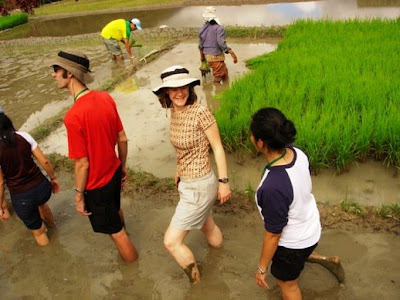 I climbed into the field with a group of others, and instantly my legs were enveloped in cool, silky mud. About two feet down the ground was solid—unlike San Francisco Bay mud, into which you could probably sink indefinitely. A local quickly instructed us on how to plant the rice. We planted about two seedlings, six or seven inches apart, moving quickly down the rows. We only had a few minutes for the whole affair, but even then I began to feel a strain in my back as I leaned over to place the seedlings in the muddy water. It made me think of the elder women I see sometimes walking down the street completely bent over—their backs bent permanently for the rest of their lives. While it was mostly just a gesture—more generous on the farmer’s part than ours—it did give me a sense of the planting process. I hope to get out in the fields some more to plant. I don’t think it will give me a true sense of the farming life, but even a deeper glimpse would be helpful.
  Soon after we planted our bundles of rice, we climbed back out of the terraces and washed off—getting ready to head on our way. While I don’t think I want to attend any more tours like that, it was helpful to see what groups like SITMO are doing to educate Filipinos and tourists about the terraces. It made me think of the tourists in Banaue, traveling on their own—often with a guide who’s not even from that barangay or municipality. Do they harm the culture more by coming unannounced, by going on the standard waterfall tours and terrace hikes without really meeting any locals? Are these group tours better, since they aim to provide a more complex education about the local heritage and cultural practices?
 The morning after the native dancing, the women in my room rose early to pack their things, standing in line to take scoop showers with water they’d boiled in the kitchen. I grabbed my backpack and headed uphill to the other hotel where we’d had dinner the night before. I grabbed my breakfast, a cup of native coffee—grown in the Cordillera mountain region (where I’m living)—fried eggs, leftover fern greens, and rice.
